

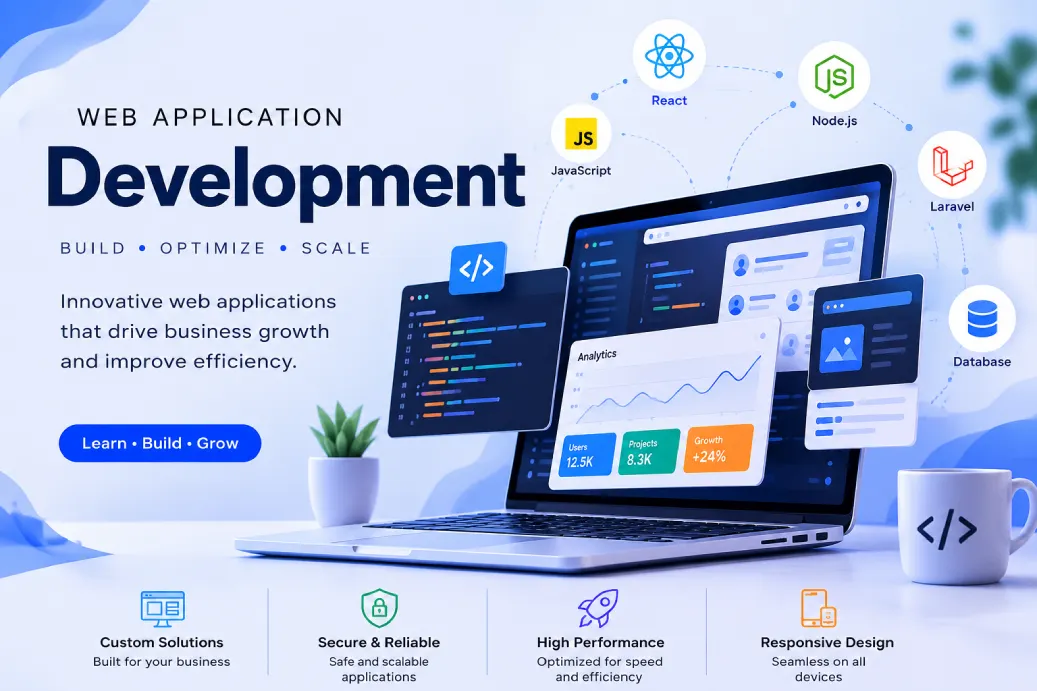
In today’s digital world, businesses need more than a traditional website to manage customers, automate processes, and deliver online services. Web application development helps businesses create interactive and customized applications that users can access directly through a web browser.
Web application development is the process of designing, developing, testing, deploying, and maintaining browser-based applications. These applications can be used for CRM systems, e-commerce platforms, booking systems, dashboards, portals, business management software, and many other business requirements.
Custom web application development allows businesses to create software according to their specific requirements. Instead of adjusting business processes to fit ready-made software, a custom application can be designed around the company's workflow, users, data, and goals.
Custom web applications can also be expanded as the business grows by adding new features, integrations, automation, and user roles.
Professional web application development services can include UI/UX design, front-end development, back-end development, database development, API integration, testing, deployment, security, and ongoing maintenance.
A good development process starts by understanding the business requirements and then selecting the right technologies and architecture for the application.
Modern web application development technologies include HTML, CSS, JavaScript, React, Angular, Vue.js, PHP, Laravel, Node.js, Python, Django, MySQL, PostgreSQL, and MongoDB. The right technology stack depends on the application's functionality, performance, scalability, security, and future requirements.
The web application development cost depends on the complexity of the project. Features, design requirements, database structure, integrations, user roles, security, hosting, and maintenance can all affect the final cost.
A simple business application will normally require less development effort than a large enterprise platform with advanced features and multiple integrations.
A professional web application development process generally starts with requirement analysis and planning, followed by UI/UX design, development, testing, deployment, and maintenance. Testing is important to ensure that the application works properly across different devices and browsers and provides a secure and reliable user experience.
Full stack web application development covers both front-end and back-end development. The front end manages the user interface, while the back end handles business logic, databases, APIs, authentication, and server-side operations.
This approach is suitable for businesses looking for complete and customized web application solutions.
Mobile web application development focuses on creating responsive applications that work smoothly on smartphones, tablets, and desktops. Progressive web application development can provide an app-like experience through technologies that support features such as fast loading, responsiveness, and offline functionality.
Enterprise web application development is designed for organizations that need scalable and secure systems to manage complex operations. ERP, CRM, HR management, financial systems, customer portals, and business dashboards are common examples of enterprise applications.
Web application development helps businesses build secure, scalable, and customized digital solutions. Whether you need a CRM, e-commerce platform, booking system, business dashboard, or enterprise application, choosing the right technology and development approach can help improve efficiency and support long-term business growth.